LedgerGuard

GST ITC control workspace

Your team ran the reconciliation. Which vendor caused the gap?

LedgerGuard turns your monthly ERP export and GSTR-2B into a governed ITC control workflow: every mismatch reason-coded, every vendor ranked by exposure, every decision routed for CA and CFO sign-off before anything ships.
Reason-coded exceptions Vendor risk ranking CA & CFO sign-off
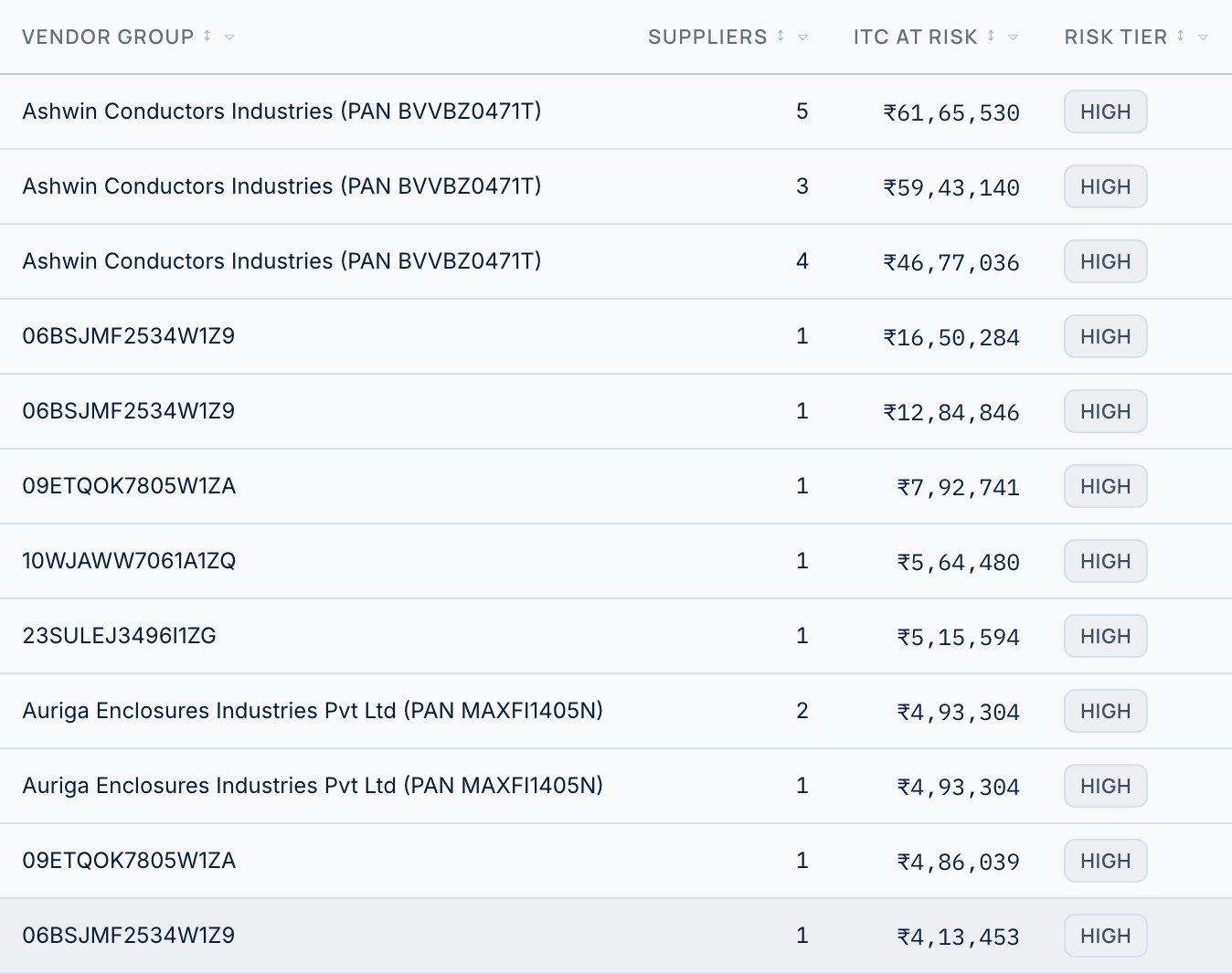
ITC at risk, by vendor group
Vendor risk table ranking supplier groups by ITC at risk. The top group carries ₹61,65,530 across five suppliers, flagged high risk.
The question your mismatch list can't answer: which vendor. Suppliers rolled up by PAN, ranked by exposure. The top group holds ₹61,65,530 at risk.

Your GSTR-2B dropped last night. Here's what your team opens.

1,145 purchase rows. 1,053 portal records. Three hours later: a mismatch list with no reason codes, no vendor rank, no priority order, and the partner needs it reviewed by tomorrow.

Reconciliation gives you

  • A list of invoices that didn't match
  • The amount that didn't reconcile
  • No context on why, or which vendor to chase

ITC control adds

  • A reason code for each exception
  • A vendor risk ranking and watchlist
  • A next action, an assignee, and a sign-off

The CFO view

The number your CFO sees first, before the CA tells them.

One sealed executive summary per month: input tax credit at risk, what's recoverable and CA-validated, and what's about to expire under the Section 16(4) window. Not a slide someone assembled by hand. A pipeline output.
Manual, inconsistent classification Machine-readable reason codesReason-code registry
No memory across monthly cycles Persistent exception identity and ageD4 · Carry-Forward Ledger
Vendor risk visible only after filing Vendor risk ranking and watchlistD3 · Vendor Risk Sheet
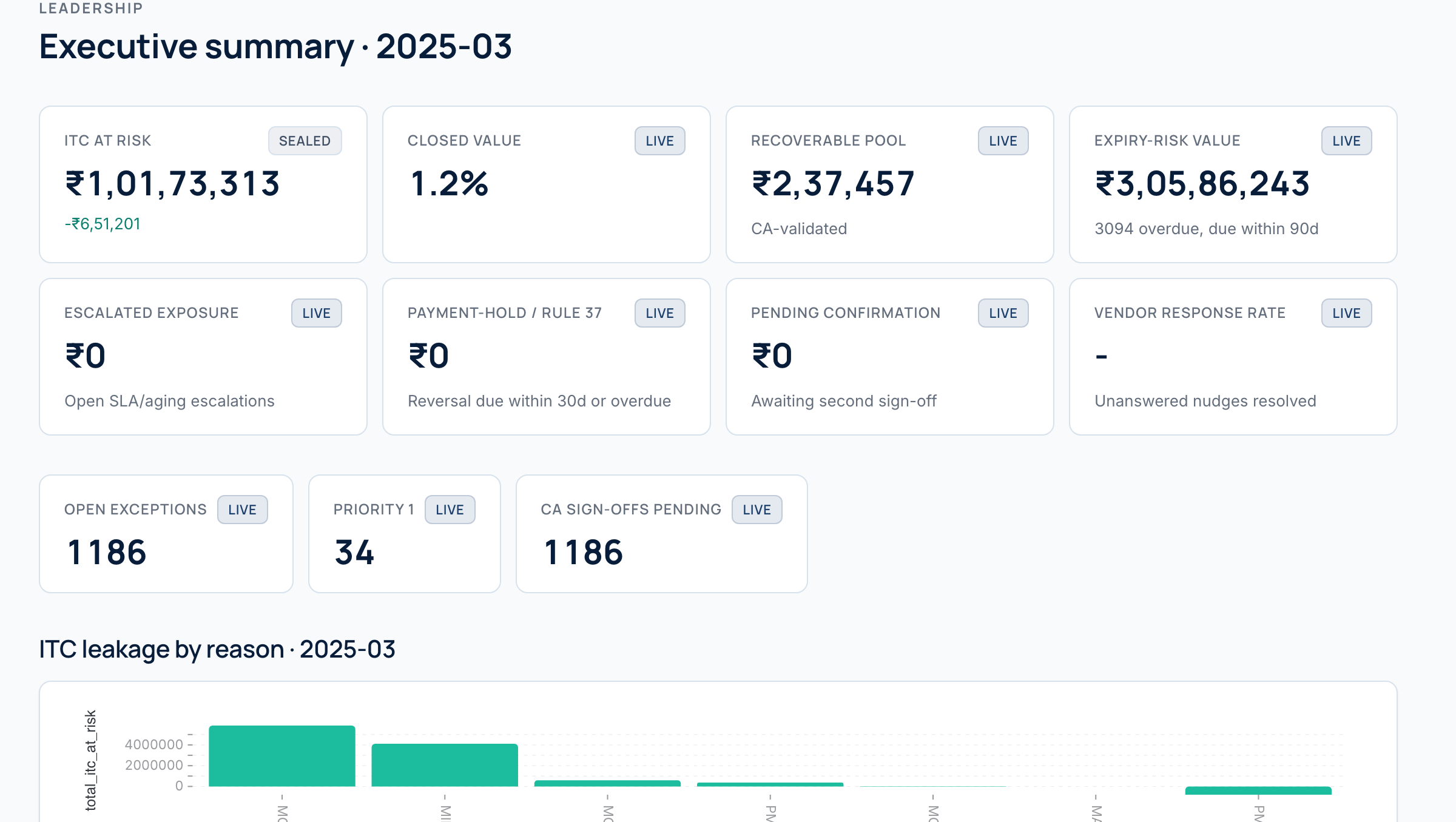
Leadership · Executive summary
Leadership executive summary: ITC at risk ₹1,01,73,313 sealed, ₹2,37,457 CA-validated recoverable, expiry-risk value ₹3,05,86,243 with 3,094 invoices overdue within 90 days, plus an ITC-leakage-by-reason chart.
ITC at risk ₹1.01 Cr · recoverable and CA-validated ₹2,37,457 · expiry-risk ₹3.05 Cr with 3,094 invoices due within 90 days. Sealed per month.
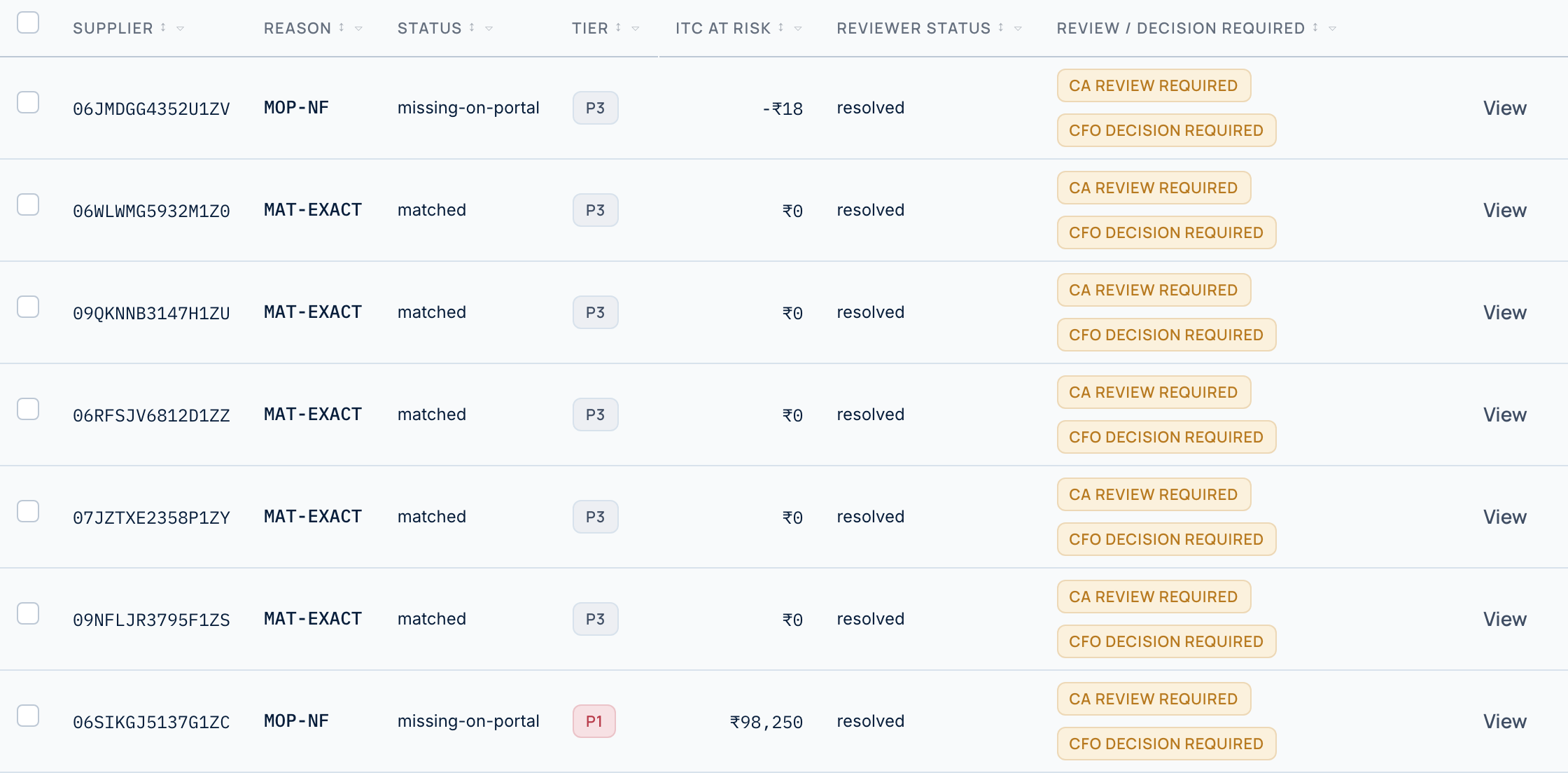
Exceptions · Review and decide
Exceptions table showing supplier GSTINs, reason codes such as MOP-NF and MAT-EXACT, tier, ITC at risk, reviewer status, and CA-review-required / CFO-decision-required badges across 3,108 rows.
Every one of 3,108 exceptions carries a reason code, a tier, an ITC-at-risk value, and a routing badge: CA review or CFO decision required.

The workflow

Every exception, classified and routed to the right desk.

No raw mismatch column. Each row is auto-classified with a reason code and a recovery bucket, assigned an owner, and routed to whoever has to decide it: analyst, CA reviewer, or CFO. Open any exception for the full evidence.
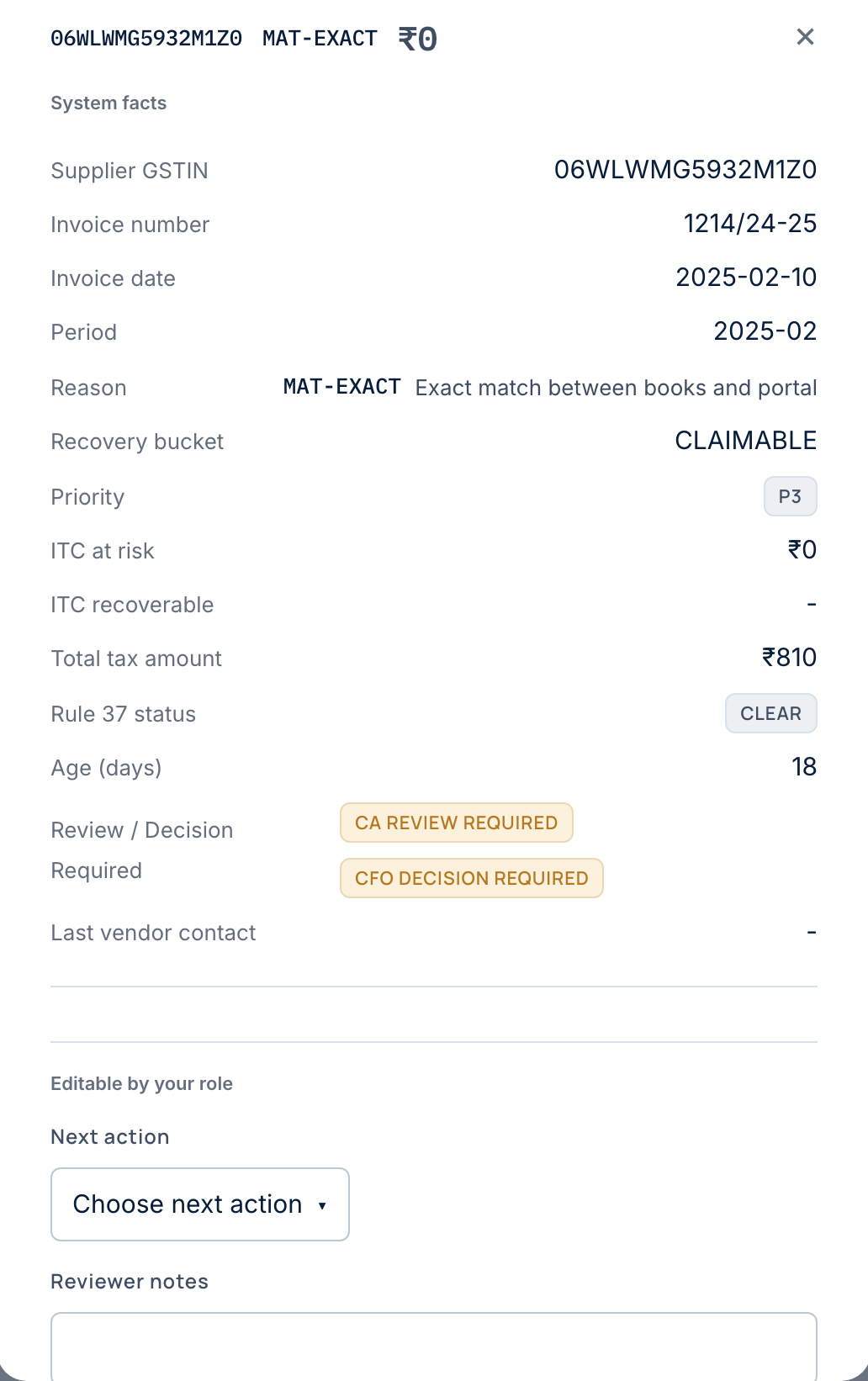
Exception detail drawer with a close button: supplier GSTIN, invoice number and date, reason ('Exact match between books and portal'), recovery bucket, Rule 37 status, age in days, ITC at risk, and CA-review / CFO-decision-required flags.
Open any exception: reason, recovery bucket, Rule 37 status, aging, and the exact ITC at stake. The evidence a reviewer needs to decide, in one place.

The product

One monthly control cycle. Seven working surfaces.

Each surface answers one question for one role, from the analyst triaging exceptions to the CA partner signing off. Every month is versioned and read-only once sealed.

itc_control · client-month · v<NNN> Versioned · Read-only once sealed
IDSurfaceWhat it answersFor
D1Exception RegisterWhat exceptions exist and how are they classified?Analyst · CA
D2ITC Leakage ReportHow much ITC is at risk, recoverable, aged, or blocked?CFO · Tax Head
D3Vendor Risk SheetWhich vendors are creating repeated exposure?Tax Head
D4Carry-Forward LedgerWhat remained unresolved from prior months?Analyst · CA
D5Leadership SummaryWhat does the CFO need to know this month?CFO
D6Audit Defense PackWhy was each decision made, and what evidence supports it?CA
D7Reviewer FeedbackWhat did analysts, CAs, and finance reviewers accept, override, or reject?CA Partner

Governance

Nothing ships until it's signed off.

The delivery gate stays closed while any CA review or CFO decision is still open. Maker records the decision, a different reviewer confirms it. Separation of duties enforced, not suggested. Every override is logged and defensible in an audit.
Maker–checker sign-off Every override logged Sealed, versioned evidence
Audit & sign-off · Delivery gate
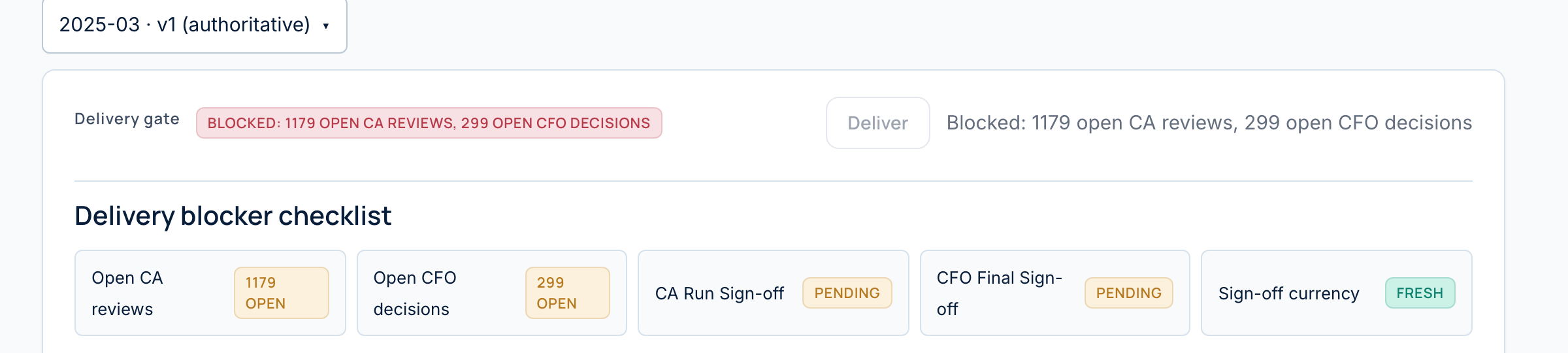
Run sign-off and delivery screen with the delivery gate marked BLOCKED (open CA reviews and open CFO decisions remain), with a delivery-blocker checklist covering CA review, CFO decision, CA run sign-off, CFO final sign-off, and sign-off currency.
The delivery gate reads BLOCKED until the blocker checklist clears: open CA reviews, open CFO decisions, and both sign-offs. No shortcut to delivered.

How it works

Three phases. One monthly control cycle.

Phase 01

Ingest

  • Validate the ERP purchase register and GSTR-2B export for required fields and structure
  • Normalize GSTINs, invoice numbers, dates, and tax values into one control model
  • Map vendor identifiers and source-row references across both data sets
Phase 02

Control

  • Reconcile books against portal data at invoice level
  • Auto-classify each exception with a reason code and a recovery bucket
  • Score vendor risk and produce a ranked watchlist for the month
Phase 03

Govern

  • Analysts and CA reviewers work a prioritized register with next actions
  • Decisions, overrides, and sign-offs are recorded in the D7 governance log
  • Unresolved exceptions carry forward with identity, age, and last action

Built for the people who own the ITC outcome.

CFO · Finance Head

You'll know what's at risk before your CA tells you.

Vendor-risk ranking and at-risk exposure ahead of the CA review. A pipeline output, not a slide assembled by hand the night before.

CA Reviewer · CA Partner

Your clients will see you differently.

Classification and reporting don't need your judgment. Your sign-off does, and the control pack preserves every decision you make.

Tax Head · Finance Analyst

Monday morning won't feel like that anymore.

A prioritized exception register with reason codes and next actions, not a raw mismatch column with no context and a deadline.

Scope clarity

Narrow by design.

We keep the problem tight because it's already hard enough: classify exceptions, preserve memory, expose vendor risk, support reviewer judgment, and defend every decision later.

What LedgerGuard is
  • A monthly ITC control workspace above your existing ERP exports and GSTR-2B data.
  • A governed exception workflow: reason codes, vendor risk, carry-forward memory, and a CFO leadership view.
  • Reviewer-assistive, with CA and finance sign-off preserved on every disposition.
What LedgerGuard is not
  • Not a GST filing tool.
  • Not an OCR engine.
  • Not an ERP connector or portal bot.
  • Not an autonomous tax-decision system.
Reviewer oversight required for every disposition. A standing rule, not a feature

Apply for a controlled pilot

We're running a controlled pilot with a small number of partners.

We work with teams where the monthly ITC control problem is measurable and technically feasible, and where a finance or CA reviewer will own the outcome.

A good pilot fit usually has

  • Multiple GSTINs, or a vendor-heavy purchase ledger.
  • ERP purchase register and GSTR-2B exports available each month.
  • CA or finance reviewer involvement in monthly closure.
  • Recurring unresolved ITC exceptions that carry across cycles.
  • A CFO, tax head, or CA partner willing to review pilot outcomes.

If this isn't the right fit If your immediate need is GST filing automation, OCR, or portal automation, LedgerGuard is likely not the right fit for the current pilot phase.